Personal Loans in Georgia: Two Sets of Rules, Split at $3,000
Georgia regulates small loans and larger loans under different laws. Loans of $3,000 or less fall under the Georgia Installment Loan Act; above that, the general interest statute and a criminal usury limit apply. Here is how each works and where to check a lender.
Cap 36% or less, by LendCedar Editorial Team Updated 6 minute read
In short
Georgia splits personal loans at $3,000. A loan of $3,000 or less is governed by the Georgia Installment Loan Act (O.C.G.A. 7-3-1 to 7-3-52), and the lender needs an installment lender license from the Department of Banking and Finance (DBF). That Act limits interest and fees; the National Consumer Law Center puts the most allowed on a $2,000 two-year loan at about 32% APR. Above $3,000, the parties may agree in writing to any simple interest rate, held back only by the criminal usury limit of 5% a month, about 60% a year.
- $2,000 loan cap
- 32% APR
- $10,000 loan cap
- 60% APR
- Small-loan law
- Loans of $3,000 or less
- Licensed by
- Georgia DBF
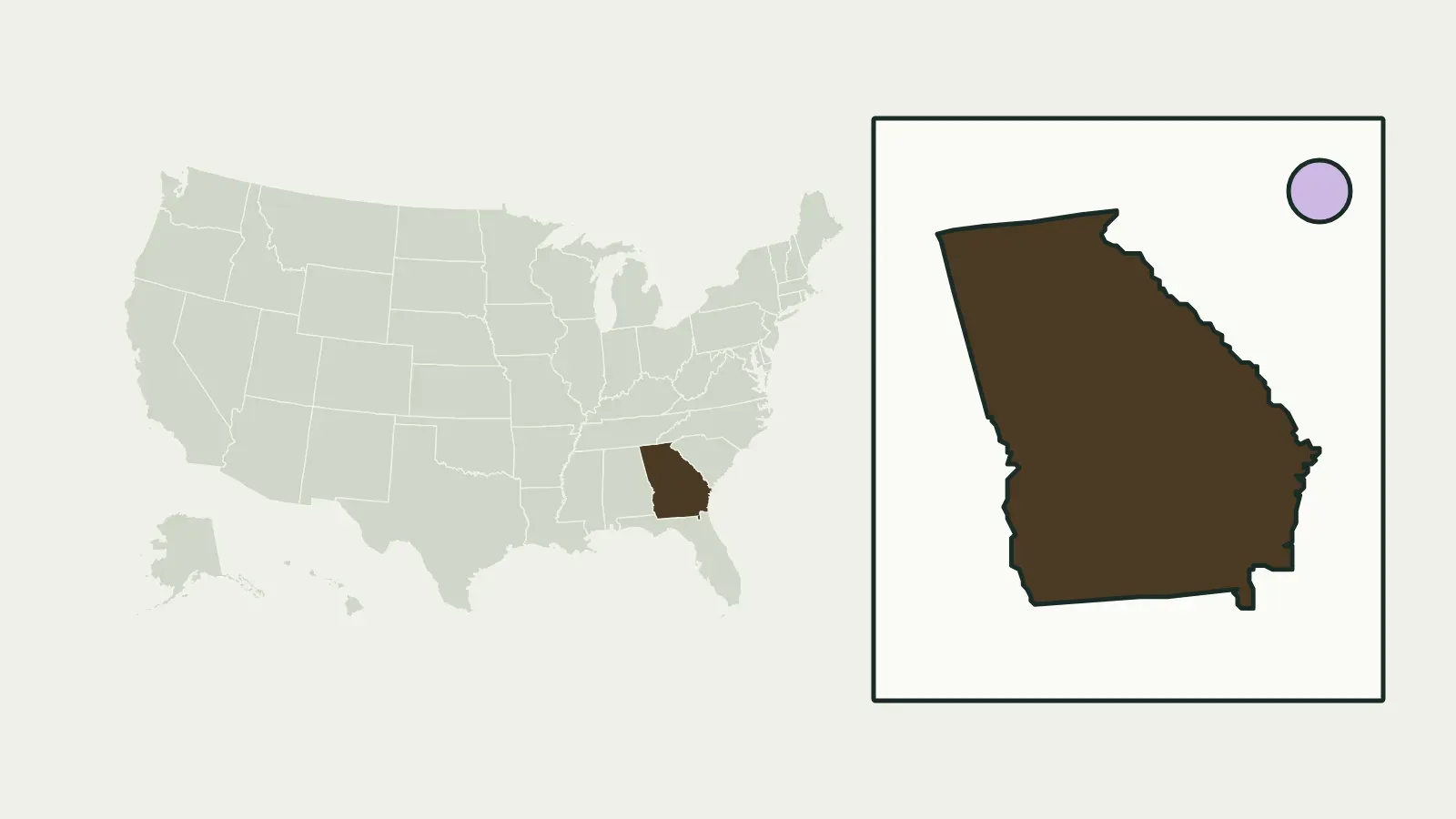
Georgia at a glance
Loans of $3,000 or less: the Installment Loan Act
The DBF describes the Georgia Installment Loan Act as the law that regulates loans of $3,000 or less and the lenders that make them. Besides interest, a licensed lender's agreement may list loan fees, a closing fee, a monthly maintenance charge and a late charge; the DBF's rule 80-14-5-.03 sets out how the closing fee and the late charge work.
The late charge is quoted in the DBF's installment loan rules: on an installment not paid within five days of its due date, the greater of $10 or 5 cents for each $1 of the installment. Because the loan fee and maintenance charge count as finance charges, the APR on your Truth in Lending disclosure will be well above the stated interest rate.
Loans over $3,000: the usury statute
For larger loans the general interest law, O.C.G.A. 7-4-2, applies. On a principal of more than $3,000 and less than $250,000, the lender and borrower may agree by written contract to any rate of interest, expressed as simple interest. The only ceiling is the criminal usury law, O.C.G.A. 7-4-18, which makes it a misdemeanor to charge more than 5% a month, directly or through fees or any other device.
| Loan size | Law | Limit |
|---|---|---|
| $3,000 or less | Georgia Installment Loan Act, O.C.G.A. 7-3 | Interest and listed fees; about 32% APR on $2,000 over two years |
| $3,000.01 to $249,999 | O.C.G.A. 7-4-2 and 7-4-18 | Any written simple-interest rate up to 5% a month |
That is why the National Consumer Law Center lists Georgia at about 60% APR on a $10,000 five-year loan (August 2023 figures), the highest $10,000 cap among the states it rates. A larger loan has fewer protections here than a small one, so the APR comparison is your main defense. Use the offer comparison calculator before you sign.
How Georgia compares with its neighbors
On the $2,000 two-year loan, North Carolina caps the price at about 35% APR, Florida at about 37% and Tennessee at about 49%, while Alabama and South Carolina have no numeric cap. The state rules map shows every state side by side.
Who needs a license
A lender making loans of $3,000 or less to Georgians needs an installment lender license from the DBF, which also runs a license search on its website. The DBF's rules for these lenders are in chapter 80-14 of the Rules of the Department of Banking and Finance.
- Banks and credit unions answer to their own charters and banking regulators, and a bank may charge the rates its home state allows.
- Online lenders that partner with a bank may make loans through that bank. Ask who the lender of record is, since that decides which rules apply.
- Payday and title loans follow other Georgia laws. Our sister site Lendmira covers them on its Georgia page.
Check a lender and file a complaint
- Look up the license in the DBF's installment lender license search before you apply for a loan of $3,000 or less.
- Keep the loan papers: the Truth in Lending disclosure, the agreement and any messages about fees. How to verify a lender lists other warning signs.
- Contact the DBF at (770) 986-1633 or toll-free (888) 986-1633, Monday to Friday, 8:00 a.m. to 5:00 p.m. Eastern Time, or at 2990 Brandywine Road, Suite 200, Atlanta, GA 30341-5565.
- Send a complaint to the CFPB as well if the lender is a bank or a bank partner, or if you are unsure who regulates it.
Sources
- Interest rates and the Georgia Installment Loan Act, O.C.G.A. 7-3 and 7-4 (Georgia Department of Banking and Finance)
- Installment lender laws and rules (Georgia Department of Banking and Finance)
- Ga. Comp. R. & Regs. 80-14-5-.03, Closing, convenience and other fees (Legal Information Institute)
- State APR caps for $500, $2,000 and $10,000 installment loans, December 2025 (National Consumer Law Center)
We checked the facts on this page against these sources on October 27, 2026. The text of O.C.G.A. 7-4-2 and 7-4-18 was read in the Official Code of Georgia Annotated; check the DBF for changes made in the most recent legislative session.
Questions people ask
What is the maximum interest rate on a personal loan in Georgia?
It depends on the size. On a loan of $3,000 or less, the Georgia Installment Loan Act limits interest and fees, about 32% APR on a $2,000 two-year loan by the National Consumer Law Center's count. Above $3,000, a written contract may set any simple interest rate up to the criminal limit of 5% a month.
Does the Georgia Installment Loan Act cover a $5,000 loan?
No. The Act covers loans of $3,000 or less. A $5,000 loan falls under the general interest statute, O.C.G.A. 7-4-2.
What late fee can a Georgia installment lender charge?
On an installment not paid within five days of its due date, the greater of $10 or 5 cents per $1 of the installment, as quoted in the DBF's installment loan rules.
Who regulates installment lenders in Georgia?
The Georgia Department of Banking and Finance licenses and examines installment lenders. See how to verify a lender for the checks to run first.
Ask lenders for real offers
Describe the loan you have in mind. LendCedar passes your request to lenders and loan brokers who may contact you with offers; you compare them and decide.
- The loan you have in mind: amount, purpose, credit and income.
- Your contact details and your consent to be contacted.
- A lender or loan broker may contact you with an offer. Nothing is decided until you sign with a lender.
LendCedar is not a lender or a loan broker and does not make credit decisions.
You pay LendCedar nothing. Lenders and loan brokers pay us for requests, and they set their own rates and terms. How we make money.
Nearby in the guide
-
Offer term
Total cost of a loan
Finance charge, APR and total of payments, with three worked offers for the same $10,000 loan.
-
Step
Verify a lender
Find the license on NMLS or with your state, match the lender of record and spot advance-fee scams.
-
Offer term
Truth in Lending disclosures
The federal box line by line: APR, finance charge, amount financed, total of payments and what sits below.