Personal Loans in Louisiana: What Licensed Lenders May Charge
The Louisiana Consumer Credit Law caps consumer loans with four rate brackets that apply to slices of the unpaid principal. Here is how they work, what a 2026 bill proposed, who needs a license, and where to check a lender.
Cap above 36%, by LendCedar Editorial Team Updated 6 minute read
In short
Under La. R.S. 9:3519, part of the Louisiana Consumer Credit Law, a consumer loan may carry up to 36% a year on the part of the unpaid principal up to $1,400, 27% on the part from $1,400 to $4,000, 24% on the part from $4,000 to $7,000 and 21% above $7,000. The lender may add an origination fee of up to $50. Finance companies need a consumer loan license from the Office of Financial Institutions (OFI). The National Consumer Law Center puts the ceiling at about 38% APR on a $2,000 two-year loan and about 27% on a $10,000 five-year loan, fees included.
- $2,000 loan cap
- 38% APR
- $10,000 loan cap
- 27% APR
- Rate brackets
- 36% / 27% / 24% / 21%
- Licensed by
- Louisiana OFI
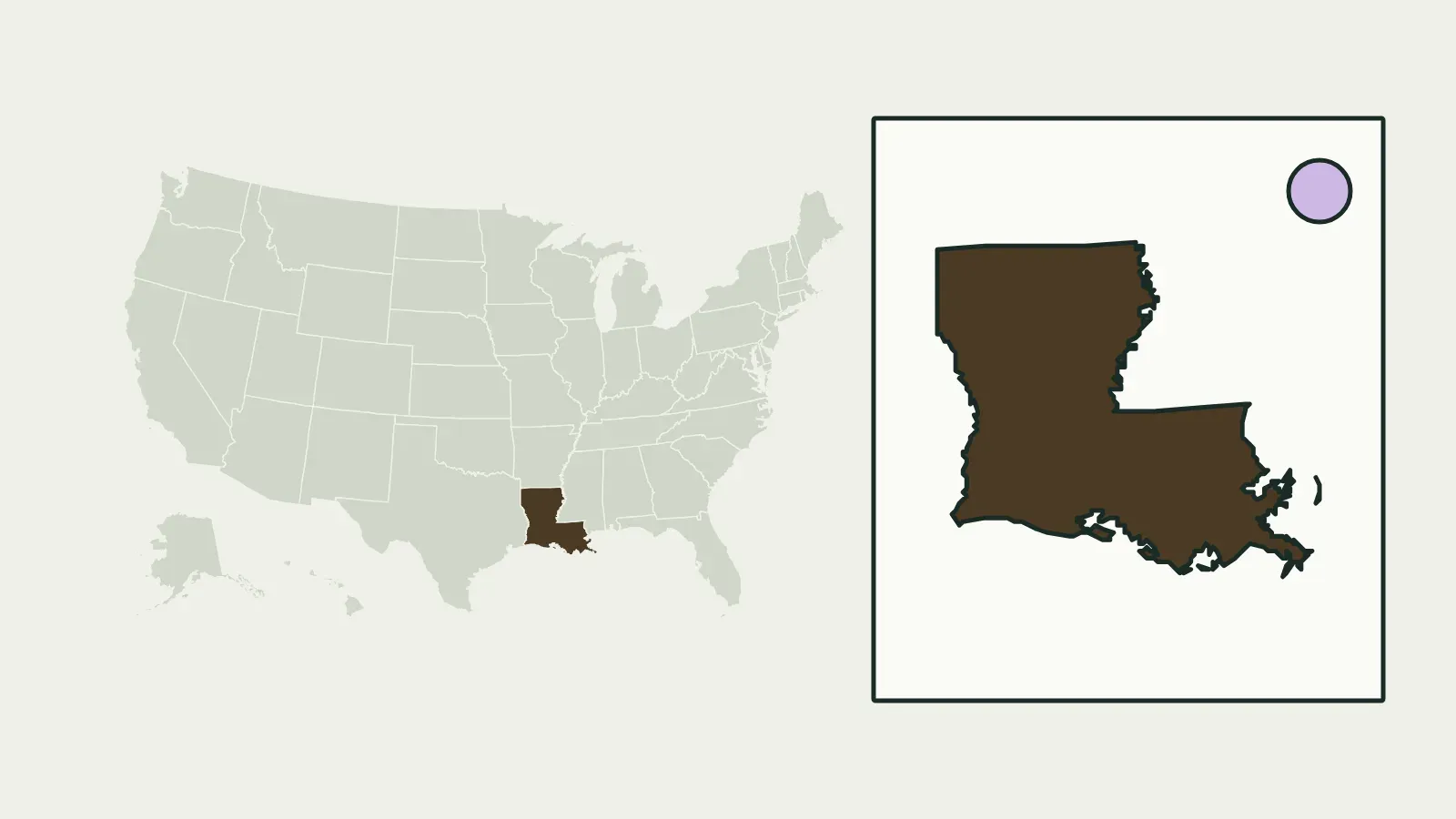
Louisiana at a glance
How the Louisiana rate brackets work
Section 9:3519 applies each rate to its own portion of the unpaid principal balance, so a larger loan has a lower blended rate. As you pay the loan down, more of what is left falls in the higher brackets, but the dollar interest shrinks with the balance.
Take a $5,000 balance as an example. The first $1,400 may carry 36% ($504 a year), the next $2,600 may carry 27% ($702) and the last $1,000 may carry 24% ($240). That is $1,446 a year at most, a blended rate of about 28.9% at the start of the loan. These figures are an illustration of the limit, not an offer.
| Portion of the unpaid principal | Maximum yearly rate |
|---|---|
| Up to $1,400 | 36% |
| $1,400 to $4,000 | 27% |
| $4,000 to $7,000 | 24% |
| Over $7,000 | 21% |
Section 9:3530 lets the lender charge an origination fee of up to $50 per consumer loan. Because the fee is a finance charge, the APR on your Truth in Lending disclosure will be higher than the contract rate, most of all on a small loan.
The 2026 bill that did not become law
House Bill 952 of the 2026 Regular Session proposed new brackets: 36% up to $2,500, 24% from $2,500 to $10,000 and 17% above $10,000, and a $75 origination fee. It passed the House on April 14, 2026, 78 to 11, and was referred to the Senate commerce committee. The Legislature's bill page lists no Senate passage, governor's action or Act number, so the brackets above remain the law. See rule changes for dated updates.
How Louisiana compares with its neighbors
On the National Consumer Law Center's comparison of a $2,000 two-year loan, Arkansas caps the loan at about 17% APR and Texas at about 37%, while Mississippi allows about 59%. For a $10,000 five-year loan, Louisiana's 27% matches Texas and sits close to Mississippi's 26%. The state rules map shows every state side by side.
Who needs a license and who does not
The OFI's non-depository division licenses finance companies, which it calls licensed lenders. A lender must hold a consumer loan license from the OFI before it begins to make consumer loans, meaning loans made mainly for personal, family or household purposes. Applicants file through NMLS, need a physical location from which loans are made, and must show at least $25,000 in unencumbered cash.
- Banks and credit unions answer to separate charters and regulators, and a bank may charge the rates its home state allows.
- Online lenders that partner with a bank may make loans through that bank, which can put the loan outside the Louisiana brackets. Ask who the lender of record is.
- Payday and title loans follow separate rules. Our sister site Lendmira covers them on its Louisiana lending laws page.
If a lender asks for a fee before it will approve or fund a loan, treat that as a warning sign; how to verify a lender explains what to check.
Check a lender and file a complaint
- Look up the license on NMLS Consumer Access or in the OFI's list of licensed lenders before you apply.
- Keep the loan papers: the Truth in Lending disclosure, the agreement and any messages about fees.
- File a non-depository complaint with the OFI in writing: download its complaint form, then mail it to the Non-Depository Division or fax it to (225) 925-4525. Questions go to the main line, (225) 925-4660.
- Send a complaint to the CFPB as well if the lender is a bank or a bank partner, or if you are unsure who regulates it.
Sources
- HB 952, 2026 Regular Session, reengrossed, with digest of present law under R.S. 9:3519 and 9:3530 (Louisiana Legislature)
- HB 952, 2026 Regular Session: bill history (Louisiana Legislature)
- Licensed lenders (Louisiana Office of Financial Institutions)
- Non-depository complaints (Louisiana Office of Financial Institutions)
- State APR caps for $500, $2,000 and $10,000 installment loans, December 2025 (National Consumer Law Center)
We checked the facts on this page against these sources on October 27, 2026. The present-law brackets and fee are as stated in the Legislature's digest of HB 952, which did not become law.
Questions people ask
What is the maximum interest rate on a personal loan in Louisiana?
Under La. R.S. 9:3519, 36% a year on the part of the unpaid principal up to $1,400, 27% from $1,400 to $4,000, 24% from $4,000 to $7,000 and 21% above $7,000, plus an origination fee of up to $50.
Did Louisiana change its loan rates in 2026?
A bill to do so, House Bill 952, passed the House in April 2026 but has no Senate passage or Act number on the Legislature's site, so the existing brackets still apply.
Who licenses personal loan companies in Louisiana?
The Office of Financial Institutions issues consumer loan licenses to finance companies, which it calls licensed lenders, through NMLS.
How do I check a Louisiana lender?
Search the company on NMLS Consumer Access or the OFI licensed lender list. See how to verify a lender for the other checks.
Ask lenders for real offers
Describe the loan you have in mind. LendCedar passes your request to lenders and loan brokers who may contact you with offers; you compare them and decide.
- The loan you have in mind: amount, purpose, credit and income.
- Your contact details and your consent to be contacted.
- A lender or loan broker may contact you with an offer. Nothing is decided until you sign with a lender.
LendCedar is not a lender or a loan broker and does not make credit decisions.
You pay LendCedar nothing. Lenders and loan brokers pay us for requests, and they set their own rates and terms. How we make money.
Nearby in the guide
-
Offer term
Total cost of a loan
Finance charge, APR and total of payments, with three worked offers for the same $10,000 loan.
-
Step
Verify a lender
Find the license on NMLS or with your state, match the lender of record and spot advance-fee scams.
-
Offer term
Truth in Lending disclosures
The federal box line by line: APR, finance charge, amount financed, total of payments and what sits below.