Personal Loans in Minnesota: What Licensed Lenders May Charge
Minnesota sets one rate rule for most consumer loans and a stricter, all-in rule for very small and short loans. Here is how each works, who needs a license, and where to check a lender.
Cap 36% or less, by LendCedar Editorial Team Updated 6 minute read
In short
Most Minnesota personal installment loans follow Statutes section 47.59: the lender may charge the greater of 21.75% a year or a graduated rate of 33% on a first slice of principal and 19% on the rest, plus a small administrative fee. Loans of $350 or less and short-term loans of $1,300 or less have a separate limit of 50% APR counting all interest and fees, and any of them above 36% requires an ability-to-repay analysis. Finance companies are licensed as regulated lenders by the Minnesota Department of Commerce.
- $2,000 loan cap
- 33% APR
- $10,000 loan cap
- 22% APR
- Small-loan limit
- 50% all-in APR
- Licensed by
- Dept. of Commerce
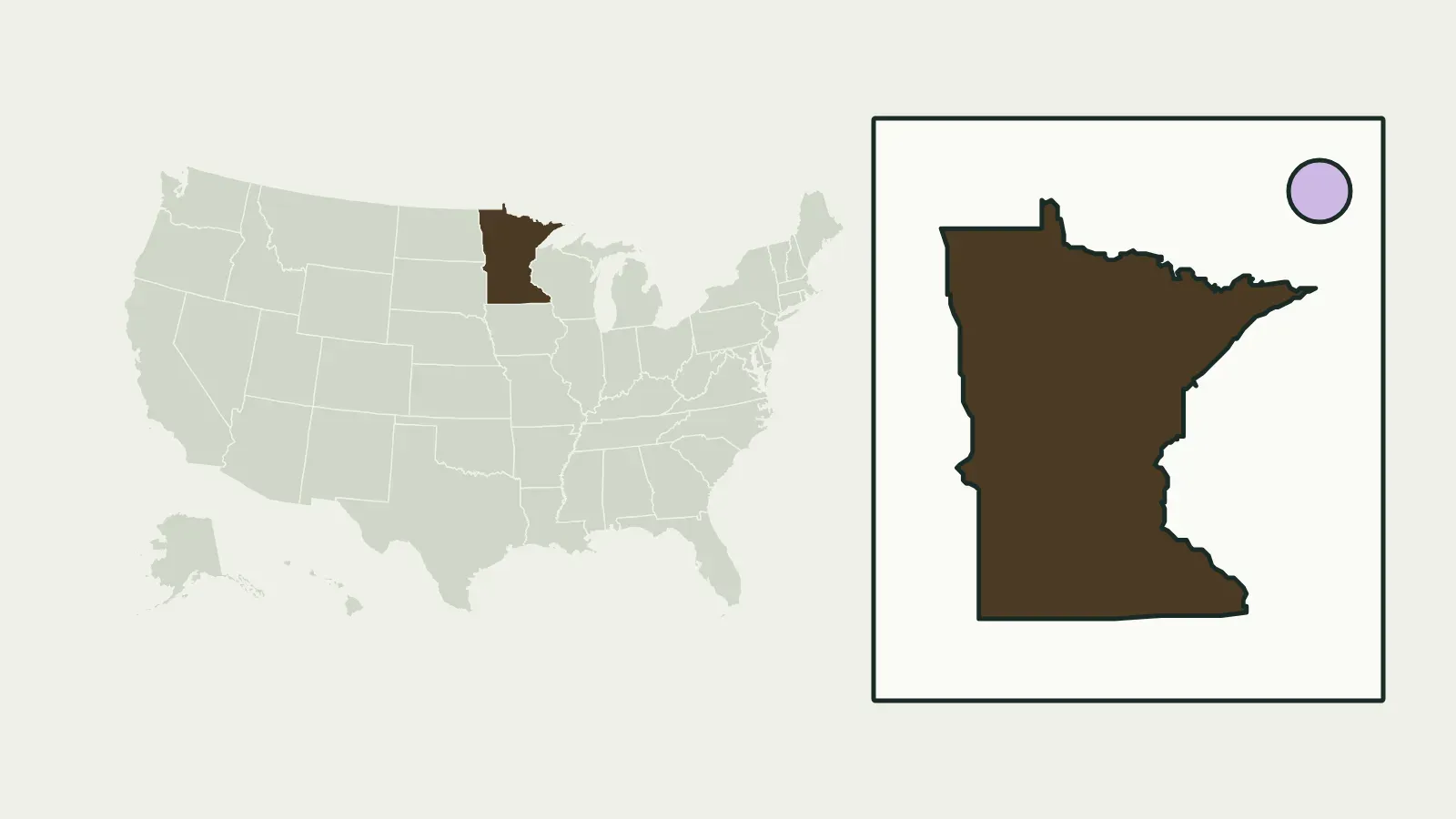
Minnesota at a glance
How the Minnesota rate limit works
Section 47.59 sets the price ceiling for consumer loans made by banks, savings institutions and regulated lenders licensed under chapter 56. Section 56.131 sends licensed lenders to these same rates. For a closed-end loan, subdivision 3 lets the lender charge whichever is greater of two options.
| Option | Maximum rate |
|---|---|
| Simple yearly rate | 21.75% APR |
| Graduated rate, first $1,425 of principal | 33% a year |
| Graduated rate, principal above $1,425 | 19% a year |
The $1,425 break point is the figure printed in the statute. Subdivision 3 ties the dollar amounts to a federal price index: they can change on July 1 of even-numbered years, and the commissioner must announce any change by April 30. On a closed-end loan with an original principal of $8,208 or less, the lender may also charge a one-time administrative fee of up to $25. The APR on your Truth in Lending disclosure includes that fee, so it can sit slightly above the contract rate.
Small and short-term loans have an all-in limit
Two smaller loan types follow separate sections. A consumer small loan under section 47.60 has a cash advance of $350 or less. A consumer short-term loan under section 47.601 has a principal of $1,300 or less, or demands a large share of the balance within 60 days. For both, the lender may charge up to 50% APR, and section 47.60 counts all interest, finance charges and fees in that APR.
- Above 36% APR, the lender must first run an ability-to-repay analysis under section 47.603, based on documented income, major obligations and basic living expenses.
- No other charges may be collected on a consumer small loan beyond those the section allows.
- Anti-evasion rules added in 2023 treat a person who holds the predominant economic interest, risk or reward in a short-term loan as the lender, even if it calls itself an agent or service provider.
Payday loans in Minnesota fall under these small-loan sections. Our sister site Lendmira covers them on its Minnesota lending laws page.
Who needs a license and who does not
Finance companies that make consumer installment loans in Minnesota are licensed as regulated lenders under chapter 56 by the Department of Commerce. Consumer small loan lenders must be a financial institution under section 47.59 or a business registered with the commissioner.
- Banks and credit unions answer to their own charters and banking regulators. A bank may charge the rates its home state allows, so an out-of-state bank can lend above Minnesota's ceilings.
- Online lenders that partner with a bank may make loans through it. For small and short-term loans, the 2023 predominant-interest rule can still make the online company the lender. Ask who the lender of record is.
Paying early, late fees and insurance
Section 47.59 lets you prepay a consumer loan at any time without penalty. A late charge is allowed only on a payment not made by the tenth day after its due date, and it may not exceed 5% of the payment or the dollar amount in the statute ($9.88 as printed), whichever is greater. See late fees and returned payments for how those charges show up in an agreement.
Subdivision 10 of section 47.59 covers credit insurance: it provides for a refund of an unearned separate insurance charge when the loan is paid off in the cases it lists, excuses refunds under $5, and bars a policy that covers more than two of the borrowers on one loan.
Check a lender and file a complaint
- Look up the license with the Department of Commerce's license lookup, by the company's name, before you apply.
- Keep the loan papers: the Truth in Lending disclosure, the agreement and any messages about fees.
- Complain to the Department of Commerce online, under its other complaint types, or at its complaints line, 651-539-1600 (800-657-3602 from Greater Minnesota). It licenses regulated loan companies and payday lenders.
- Send a complaint to the CFPB as well if the lender is a bank or a bank partner, or if you are unsure who regulates it.
Nearby, Iowa, North Dakota and South Dakota cap a $2,000 two-year loan at about 36% APR on the National Consumer Law Center's comparison, while Wisconsin has no numeric cap. The state rules map shows every state, and how to verify a lender lists the checks to run.
Sources
- Minnesota Statutes section 47.59 — Financial institution loans and credit sale contracts (Revisor of Statutes)
- Minnesota Statutes section 47.60 — Consumer small loans (Revisor of Statutes)
- Minnesota Statutes section 47.601 — Consumer short-term loans (Revisor of Statutes)
- Minnesota Statutes section 47.603 — Ability to repay analysis (Revisor of Statutes)
- Minnesota Department of Commerce — file a complaint and license lookup
- State APR caps for $500, $2,000 and $10,000 installment loans, December 2025 (National Consumer Law Center)
We checked the facts on this page against these sources on October 27, 2026. A 2026 law (chapter 124) amended the definitions in sections 47.59 and 47.60; the Revisor's 2025 text above does not yet show that change.
Questions people ask
What is the maximum interest rate on a personal loan in Minnesota?
For most consumer loans under section 47.59, the greater of 21.75% APR or 33% a year on the first $1,425 of principal and 19% on the rest (dollar amounts as printed in the statute), plus a one-time fee of up to $25 on loans of $8,208 or less.
Does Minnesota have a 36% cap?
Not as a flat cap on all loans. Consumer small loans of $350 or less and short-term loans of $1,300 or less may reach 50% APR counting all fees, but above 36% the lender must first confirm you can repay under section 47.603.
Do the Minnesota limits apply to banks?
Section 47.59 covers Minnesota banks and regulated lenders, but an out-of-state bank can charge the rates of its home state. Ask any online lender which company is the lender of record.
How do I check a Minnesota lender?
Search the company in the Department of Commerce license lookup, or call 651-539-1600. See how to verify a lender for the full checklist.
Ask lenders for real offers
Describe the loan you have in mind. LendCedar passes your request to lenders and loan brokers who may contact you with offers; you compare them and decide.
- The loan you have in mind: amount, purpose, credit and income.
- Your contact details and your consent to be contacted.
- A lender or loan broker may contact you with an offer. Nothing is decided until you sign with a lender.
LendCedar is not a lender or a loan broker and does not make credit decisions.
You pay LendCedar nothing. Lenders and loan brokers pay us for requests, and they set their own rates and terms. How we make money.
Nearby in the guide
-
Offer term
Total cost of a loan
Finance charge, APR and total of payments, with three worked offers for the same $10,000 loan.
-
Step
Verify a lender
Find the license on NMLS or with your state, match the lender of record and spot advance-fee scams.
-
Offer term
Late fees and returned payments
Where the late charge appears, why the APR leaves it out, state limits in Ohio and Florida, and federal rules.